
Why Does Poultry Lighting Matter for Breeding Results?
Light affects poultry behavior, feeding, reproduction, and growth. A farm can manage feed, ventilation, and housing carefully, but poor lighting can still reduce the value of the investment.
For broilers, lighting helps guide feeding activity, movement, flock comfort, and growth rhythm. For layers, the light schedule can influence reproductive hormone activity and egg production, which is why many farms use artificial light to extend or stabilize the photoperiod.
This guide focuses on practical farm questions: what poultry lights are, which fixture types are commonly used, how lighting affects poultry, why LEDs are usually preferred, and how ShineLong's Rancher IP69K LED luminary fits demanding poultry house environments.

Which Types of Poultry Lighting Exist in Chicken Farms?
Poultry farmers commonly compare five lighting types: incandescent lights, fluorescents, mercury vapor lights, CF or compact fluorescent lights, and LED poultry lighting. Each option has a different cost, lifespan, efficiency level, heat profile, and suitability for poultry houses.

750-1,000 hours
Incandescent Lights
These are usually the cheapest poultry lighting fixtures, but also the least efficient and least durable. Reflectors are often needed to get better usable light from them.

Up to 10,000 hours
Fluorescents
Fluorescent luminaires are almost four times more efficient than incandescent lamps and can last much longer, but they may flicker before switching on.

Up to 24,000 hours
Mercury Vapor Lights
Mercury vapor lights can provide a longer lifespan, but they cost more to buy and maintain, take time to start, and generate heat that is unsuitable for low ceilings.

5x efficiency gain
CF Lights
Compact fluorescent lights improve on standard fluorescents and can be around five times more efficient than incandescent lamps, but they still are not the strongest poultry farming option.

Up to 75,000 hours
LED Poultry Lighting
LED poultry lighting addresses many weaknesses of older technologies, offering long service life, high efficiency, instant switching, control options, and lower operating cost.
| Lighting Type | Main Benefit | Main Limitation | Best Use in Poultry Farms |
|---|---|---|---|
| Incandescent lights | Low purchase cost | Low efficiency, high heat, and short 750-1,000 hour life | Only where low first cost matters more than operating cost |
| Fluorescents | Almost four times more efficient than incandescent lights | May flicker before switching on and can be less convenient | Older farms where fluorescent infrastructure already exists |
| Mercury vapor lights | Up to 24,000 hours of lighting | Higher cost, delayed startup, and heat generation | Less suitable for low-ceiling poultry rooms |
| CF lights | Improved efficiency over standard fluorescents | Still not the most durable or poultry-focused choice | Basic energy-saving replacement where LED upgrade is delayed |
| LED poultry lighting | Up to 75,000 hours, high efficiency, and up to 80% lower energy cost in the lighting comparison | Higher upfront fixture cost than basic lamps | Modern broiler, layer, breeder, and washdown-prone poultry houses |
How Does Lighting Affect Broilers and Laying Hens?
Lighting is important in broiler farming because it helps guide feeding, behavior, activity level, and growth. A poorly lit chicken coop can increase fear or aggression, reduce healthy feeding behavior, and affect flock growth.
Lighting also matters for laying hens. Longer or better-controlled daylight can support egg production by influencing reproductive hormone activity, including FSH and LH. Many poultry lighting recommendations use at least 16 hours of light for laying poultry to help maximize egg production.
For farms that need application-specific planning, ShineLong also provides a dedicated chicken farm lighting solution page for project-level selection.

Which ShineLong LED Fixture Fits Poultry House Environments?
ShineLong Rancher LED luminary is suited to poultry houses because these spaces need more than basic brightness. A suitable fixture should resist water, dust, vapor, impact, corrosion, aging, and frequent cleaning conditions.
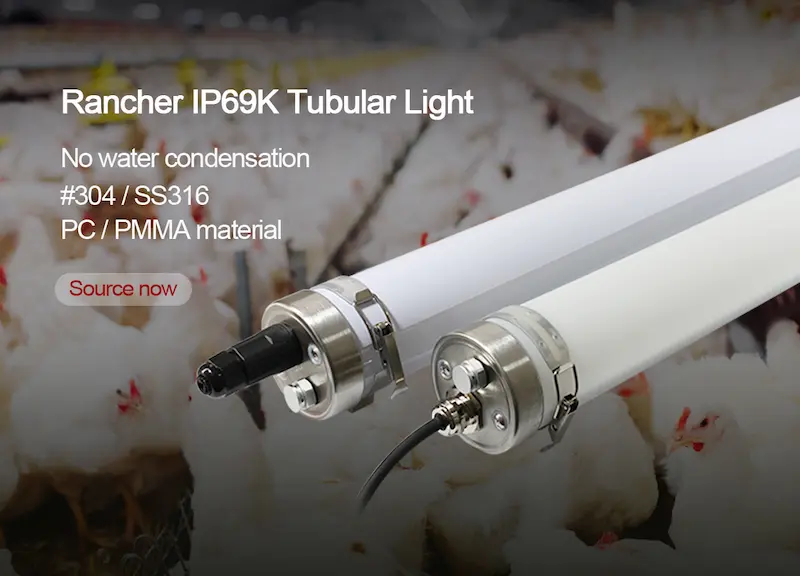
Rancher IP69K LED Luminary
Rancher offers IP69K and IK10 protection, 75,000-hour lighting life, 130-160 lm/W efficiency, -20 to 50 degrees Celsius operation, corrosion resistance, and multiple connection options.
View product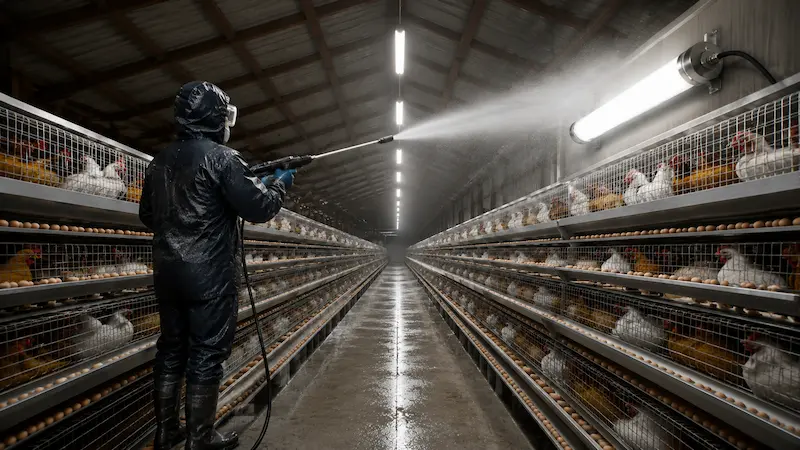
Chicken Farm Lighting
For broiler and layer houses, fixture selection should consider brightness, light schedule, installation height, cleaning method, and flock production stage.
View application
Poultry and Farm Lighting Guides
Compare lighting knowledge for poultry houses, farm buildings, cow houses, and other agricultural spaces that need durable LED fixtures.
Read guides