
Which Rating Should You Specify for Washdown LED Lighting?
Specify IP69 when the project requires IEC 60529 evidence, or IP69K when it requires ISO 20653 evidence. Both address close-range, hot, high-pressure water jets; neither label alone proves that a particular fixture suits your cleaning process. Match the required standard, edition and test report to the exact luminaire configuration.
For food processing, car washes and other washdown-intensive projects, the important question is not whether the letter K sounds stronger. It is whether the documented test conditions, cable entry, mounting arrangement and cleaning process match the installation. Explore ShineLong’s LED tri-proof lighting range when comparing fixture families.

What Do IP69 and IP69K Ratings Mean?
Both ratings combine dust-tight protection with a hot, high-pressure water-jet test, but they cite different standards. IP69 uses IEC 60529 terminology; IP69K uses ISO 20653 terminology. In each code, 6 means dust-tight, while 9 or 9K identifies the water-jet test. A report covering only water ingress should state IPX9 or IPX9K, not a full IP69 or IP69K rating.
The codes are not a universal scale where a larger number automatically covers every lower water test. A high-pressure washdown test and an immersion test impose different sealing stresses. Therefore, a project that needs both scenarios should ask for both relevant ratings and reports. For the broader classification system, see ShineLong's IP rating guide.
How Do IP69 and IP69K Test Methods Differ?
The main difference is the governing standard and its prescribed test setup, not a simple stronger-versus-weaker ranking. IEC 60529 defines IP69 for electrical enclosures, with some test details depending on enclosure size; ISO 20653 defines IP69K for road-vehicle electrical equipment. For a washdown LED light, compare the report's standard, edition and tested configuration before treating the two claims as interchangeable.
| Point to compare | IP69 | IP69K |
|---|---|---|
| Standard context | IEC 60529, for electrical enclosures. | ISO 20653, developed for electrical equipment on road vehicles. |
| Water-test designation | IPX9 when only the water test is stated. | IPX9K when only the water test is stated. |
| Test relationship | Designed for hot, high-pressure water-jet exposure; exact apparatus details should be read from the applicable edition. | Uses a defined high-pressure, high-temperature, close-range washdown method. |
| Specification decision | Suitable when the project or certification basis calls for IEC 60529. | Suitable when the project calls for ISO 20653 / IP69K documentation or a washdown specification built around it. |
What Happens During an IP69K Washdown Test?
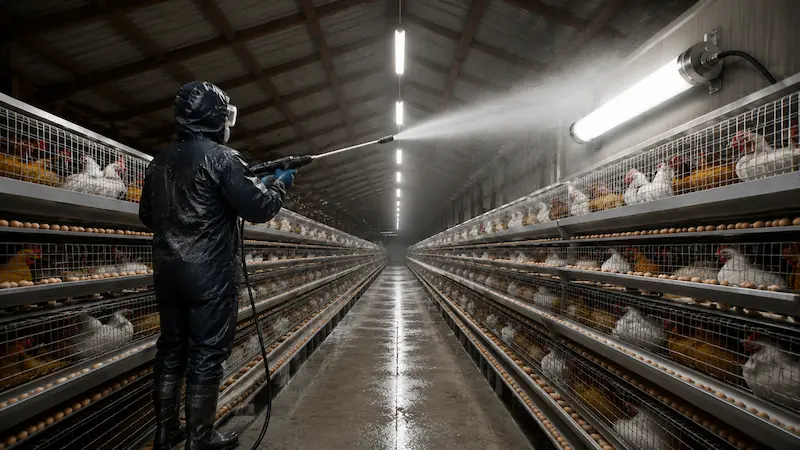
The luminaire enclosure is exposed to close-range jets of hot, high-pressure water at specified angles to check for harmful ingress. Commonly cited ISO 20653 IP69K conditions include water at 80 °C ± 5 °C, pressure of 80–100 bar, flow of 14–16 L/min, a 100–150 mm nozzle distance, and 30-second exposure at each of four angles: 0°, 30°, 60° and 90°. Confirm the applicable standard edition and the actual laboratory setup in the report for the model being considered.

The purpose of the test is to assess whether water ingress has a harmful effect under the prescribed condition. It does not prove suitability for every cleaning chemical, continuous steam exposure, electrical connection method, submersion depth or installation orientation. Those factors need separate review.
Does an IP69K Rating Also Cover IP68 Immersion?
No. IP68 evaluates immersion; IP69K evaluates dynamic hot, high-pressure washdown. An enclosure can be robust in one scenario and still need separate evidence for the other. IP68 conditions are defined by the manufacturer and user but must be more severe than IPX7; they should always be read alongside the stated immersion depth and duration.
For a food plant or car-wash project, choose the tests that reflect the actual risk: washdown pressure and temperature, cleaning distance, chemicals, condensation, temporary flooding, or immersion. For high-pressure cleaning zones, see ShineLong’s food-processing IP69K lighting guide; for wash bays, review the car-wash lighting application guidance.
What Should Buyers Check Before Specifying a Washdown Luminaire?
Check the site's cleaning conditions against the exact fixture's test report and installed configuration. The IP code is only one part of the decision; cable entries, cleaning chemistry and lighting performance also need separate review.
- Match the site cleaning procedure to the rating: water temperature, pressure, distance, angle and frequency all matter.
- Request the complete report or certificate for the exact model, diffuser, cable gland, connector and mounting arrangement proposed.
- Check whether IP69/IP69K, IP67/IP68, impact resistance, chemical resistance or market-specific documentation are separately required.
- Review the system boundary: a rated luminaire can lose its effective protection through an unsuitable connector, cable entry or field installation.
- Confirm optical output, colour rendering, glare, mounting height and controls after the environmental requirements are defined.
What Does an IP Rating Leave Out of a Washdown Specification?
An IP rating does not by itself verify chemical resistance, corrosion performance or the protection of field-installed connections. It records a specific enclosure test. Connect the report to the cleaning routine, supplied accessories and installation details before approving a fixture.
- Test evidence: confirm the cited standard and its edition.
- Product configuration: match the report to the actual housing, lens, cable and accessories.
- Environment: review cleaning chemistry, corrosion, temperature cycling and condensation separately.
- Installation: protect cable entries and connectors so the installed system maintains the intended protection.
Which ShineLong Fixture Can Be Reviewed for IP69K Washdown Projects?
The Rancher IP69K LED Tri-proof Light is a relevant candidate. Confirm the exact model, cable entry, test standard and report against your washdown requirements before specifying it.

Rancher IP69K LED Tri-proof Light
For projects with documented high-pressure washdown requirements, verify the exact Rancher configuration with ShineLong before it is specified. The product page is the current source for model-specific options and documents.
- Designed for demanding washdown applications
- Project-led review of model, materials and documentation
- Suitable starting point for food processing and car-wash discussions