
Why Lighting Determines Chicken Farm Productivity
Scientific poultry lighting directly impacts growth rate, egg production, and feed efficiency.

Lighting directly affects growth rate, egg production, feed conversion ratio (FCR), and flock behavior in poultry farming.
Traditional lighting systems often cause instability in brightness and spectrum, leading to inefficiency and higher stress levels.
Modern poultry lighting systems are engineered based on avian visual biology and spectral science for optimal performance.
Learn more about our IP69K poultry lighting systems.
Technical Note: This article is based on LED spectral engineering principles, poultry vision biology research, and industrial lighting performance data from large-scale poultry farming environments.
Chicken Vision & Light Spectrum Requirements
Understanding how chickens perceive light is the foundation of scientific poultry lighting design
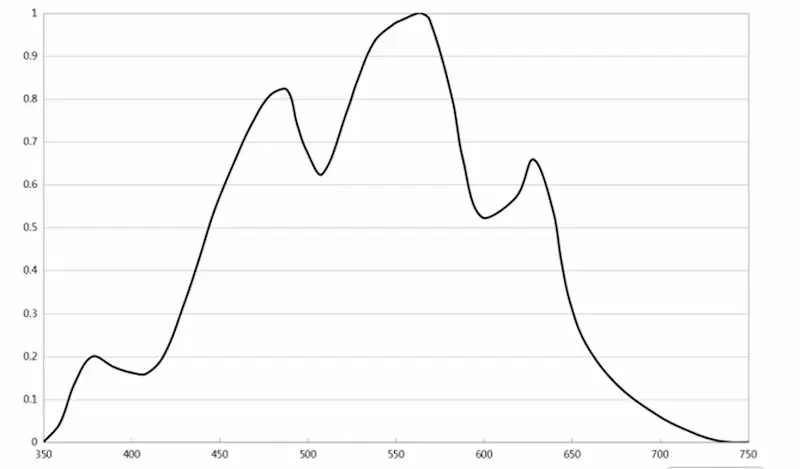
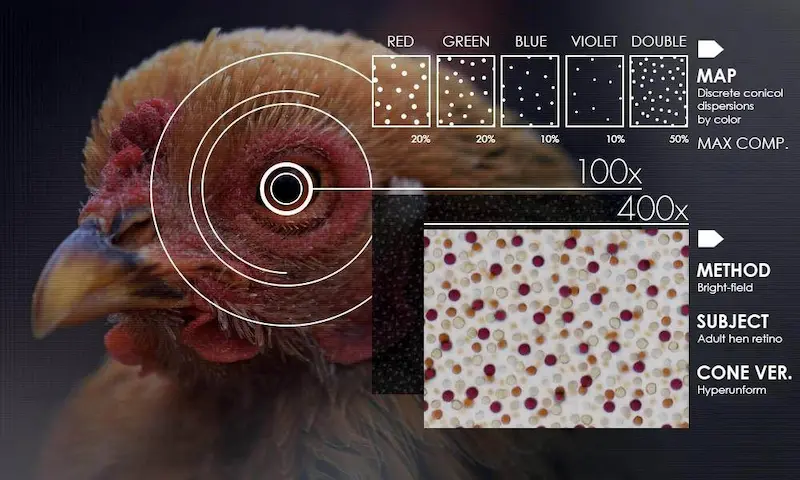
Chickens have a significantly different visual system compared to humans. Their retina contains four types of cone cells, enabling them to perceive ultraviolet, blue, green, and red light within a wavelength range of 350–750nm.
UV Light (350–400nm)
Chickens can perceive ultraviolet light, which plays a key role in natural behavior recognition, feeding patterns, and environmental awareness. It helps simulate natural daylight conditions inside poultry houses.
Blue Light (470–490nm)
Blue light has a calming effect on poultry. It reduces stress levels, minimizes aggressive behavior, and improves flock stability, especially in high-density farming environments.
Red Light (620–640nm)
Red light supports reproductive performance and egg production. It is widely used in layer farms to stabilize laying cycles and improve long-term productivity.
Why IP69K Protection Is Critical for Chicken Farm Lighting
Harsh poultry environments require industrial-grade lighting designed for water, ammonia, dust, and high-pressure cleaning
Poultry farms are one of the most demanding environments for lighting systems. High humidity, ammonia gases, dust accumulation, and frequent high-pressure cleaning can quickly damage ordinary lighting fixtures, leading to high maintenance costs and frequent replacements.
Standard Lighting (IP54–IP65)
✖ Limited water resistance
✖ Vulnerable to ammonia corrosion
✖ Shorter lifespan in humid environments
✖ Frequent replacement cost
IP69K LED Poultry Lighting
✔ Withstands high-pressure wash (up to 1450 psi)
✔ Resistant to ammonia corrosion
✔ Sealed PC/PMMA housing design
✔ Stainless steel 316 hardware protection
✔ 50,000+ hours long lifespan
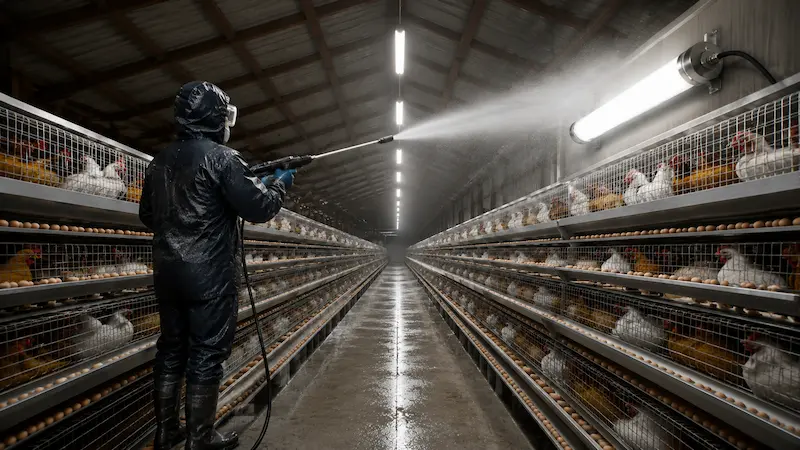
IP69K-rated lighting systems are specifically designed for environments requiring high-temperature, high-pressure cleaning. After each production cycle, chicken farms must disinfect facilities using hot water and strong water jets, which can easily damage ordinary fixtures.
With fully sealed housing structures and corrosion-resistant materials, professional poultry lighting ensures stable operation even in extreme conditions, significantly reducing maintenance downtime and operational costs.
Explore industrial-grade lighting solutions for harsh environments:
View IP69K LED Lighting SolutionsHow Flicker-Free Lighting Impacts Poultry Behavior & Welfare
Light stability directly affects stress levels, aggression behavior, and egg production efficiency in poultry farms
Chickens are highly sensitive to light fluctuations. Unlike humans, poultry can detect flicker frequencies up to 205Hz, which makes lighting stability a critical factor in farm productivity and animal welfare.
Low-Quality Lighting (With Flicker)
✖ Causes stress and anxiety in poultry
✖ Triggers aggressive behavior and feather pecking
✖ Reduces feed intake efficiency
✖ Decreases egg production stability
Flicker-Free LED Poultry Lighting
✔ Stable constant-current driver technology
✔ Reduces stress and aggressive behavior
✔ Improves flock stability and welfare
✔ Supports consistent egg production cycles
Flicker in lighting systems is often caused by unstable power drivers or low-quality LED components. While it may not be visible to humans, poultry are highly sensitive to these fluctuations, which can disrupt their nervous system response.
In commercial poultry farming, flicker-free lighting is essential not only for productivity but also for maintaining animal welfare standards and long-term flock health.
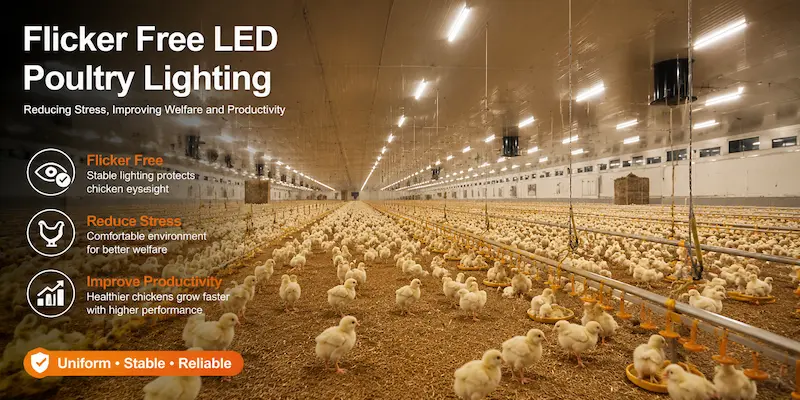
Upgrade your poultry lighting system with stable, flicker-free LED technology:
Explore Flicker-Free LED Solutions