
What Is the Difference Between Vapor-Tight and Tri-Proof Lighting?
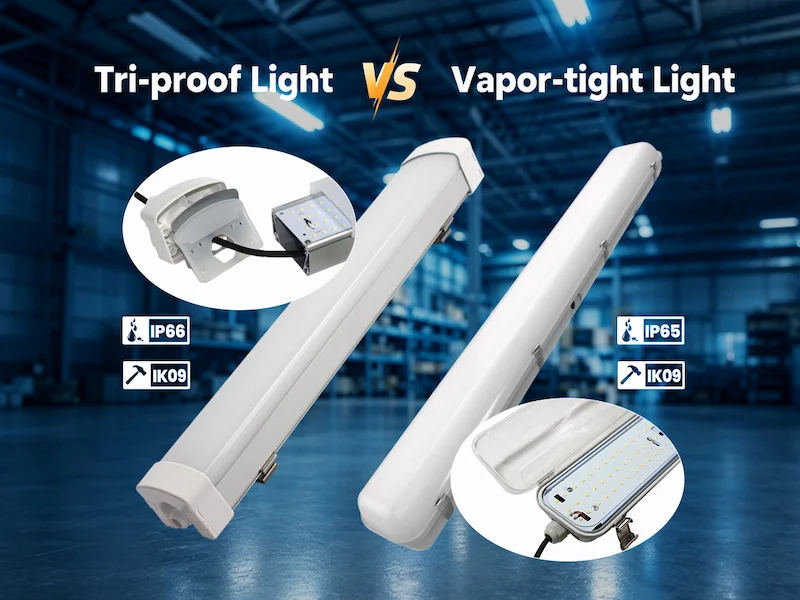
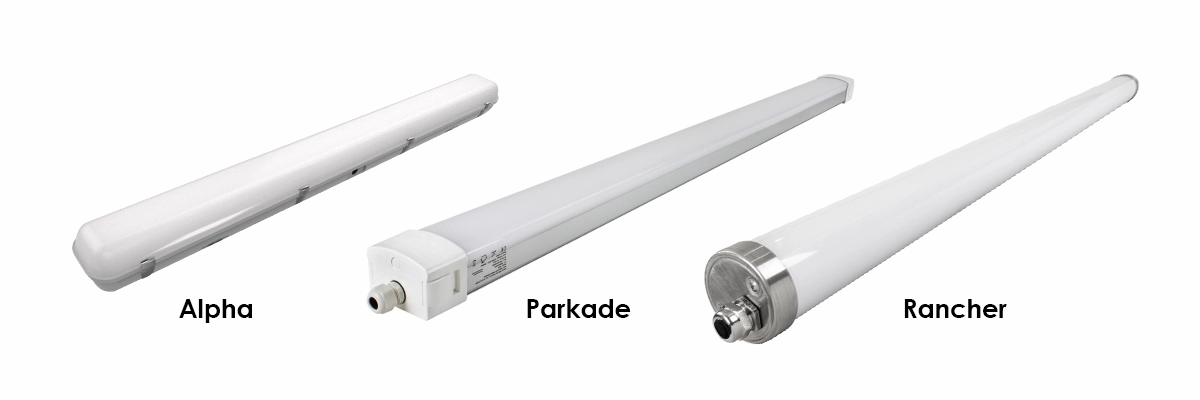
Vapor-tight and tri-proof are overlapping product descriptions, not a universal pair of performance grades. In ShineLong’s range, Alpha uses the vapor-tight name with IP65 protection, while Parkade and Rancher use tri-proof names with different enclosure and application options.
Choose from the model specification: IP rating, housing and seals, impact configuration, ambient temperature, electrical version and required approvals.
Start with the tri-proof lighting definition if you need to separate water, dust, corrosion and impact requirements.
How Should Buyers Interpret These Two Lighting Terms?
Vapor-tight and tri-proof are widely used product descriptions for protected industrial linear lights. The final selection should be based on the complete fixture specification and the conditions at the installation site.
| Question | Vapor-tight | Tri-proof |
|---|---|---|
| What does the term usually communicate? | An enclosed fixture designed for the environmental exposure stated for the selected model. | A protected fixture commonly selected for wet, dusty or corrosive industrial environments. |
| Does the name specify an exact IP level? | No. The declared IP rating belongs to the selected model. | No. The declared IP rating belongs to the selected model. |
| Does the name establish chemical resistance? | Material compatibility depends on the housing, seals and cleaning exposure. | Material compatibility depends on the housing, seals and cleaning exposure. |
| Does the name establish explosion protection? | Hazardous-location suitability requires a dedicated approved product. | Hazardous-location suitability requires a dedicated approved product. |
| How do I choose? | Compare IP and IK ratings, material, voltage, installation method and approval scope. | Compare IP and IK ratings, material, voltage, installation method and approval scope. |
Selection tip: The name alone does not define the full protection level. Choose the product that matches the cleaning process, ambient temperature, material exposure and electrical requirements of the site.
Which Environmental Questions Should Come Before the Product Name?
- For damp or dusty spaces, define the water exposure and cleaning method.
- For hot-water washdown, verify the applicable IP69K test and detergent compatibility.
- For cold rooms, confirm the actual operating temperature and condensation conditions.
- For hazardous areas, obtain the separately suitable luminaire and approval scope.
- If operation in a low-temperature environment of -40°C is required, ShineLong can provide a suitable solution.

What Should a Buyer Confirm Beyond the Enclosure?
A purchase specification should identify voltage, control protocol, wiring entry, mounting accessories, emergency requirements and the final product code. A suitable housing does not resolve electrical or installation compatibility.
The Alpha, Parkade, and Rancher series support AC100–277V input and 0/1–10V dimming for the US market, while EU versions support AC200–240V input with DALI or 0/1–10V dimming options. Please verify the local voltage requirements and specific feature compatibility before purchasing.
