Industrial Lighting Guide

How to Choose Industrial LED Lighting?

Match industrial LED lighting to each work zone, then verify maintained light levels, glare, enclosure protection, and lifetime cost.

A high-bay warehouse, an inspection station, and a washdown room can share a roof and still need different lighting. For each zone, record the visual task, mounting height, exposure, and access for maintenance. Once you have those inputs, shortlist industrial lighting fixture types and compare layouts that meet the same design targets.

Overhead lighting above a high-rack warehouse aisle

What Should You Specify Before Comparing Fixtures?

Set maintained illuminance, uniformity, and applicable glare limits for each task area. Identify the surfaces where people need to see detail and the positions from which they do the work.

Maintained illuminance, measured in lux, is the light level the design is intended to maintain through the planned maintenance interval. Use the applicable local standard and project requirements to set targets. For indoor projects where it applies, BS EN 12464-1 organizes lighting requirements by task or activity. In a warehouse, check vertical light on rack labels as well as horizontal light on the aisle floor. At an inspection bench, place the calculation plane on the actual work surface and check reflections from the material being inspected.

Work zoneFixture types to evaluateWhat to verify in the layout or specification
Open warehouse or production bay Round or linear high-bay fixtures Maintained light levels, uniformity, and glare at the proposed mounting height and spacing
Racked aisles and pick faces Linear high bays or fixtures with aisle optics Vertical light on rack faces, aisle-floor uniformity, and driver sightlines
Assembly and inspection stations General lighting with local task lighting where needed Illuminance on the work surface, colour rendering, shadows, and reflected glare
Washdown or wet process rooms Sealed linear or tri-proof fixtures suited to the cleaning regime Ingress test evidence, cleaning-agent compatibility, and any hygiene requirements
Outdoor yards and loading areas Area lights or floodlights with appropriate optics Light on loading and traffic routes, glare toward drivers, spill light, and weather exposure

Which IP Rating Does Each Zone Need?

Select the ingress protection rating for the dust and water exposure at the installed fixture. Specify impact resistance, corrosion resistance, and suitability for classified hazardous locations separately wherever those conditions apply.
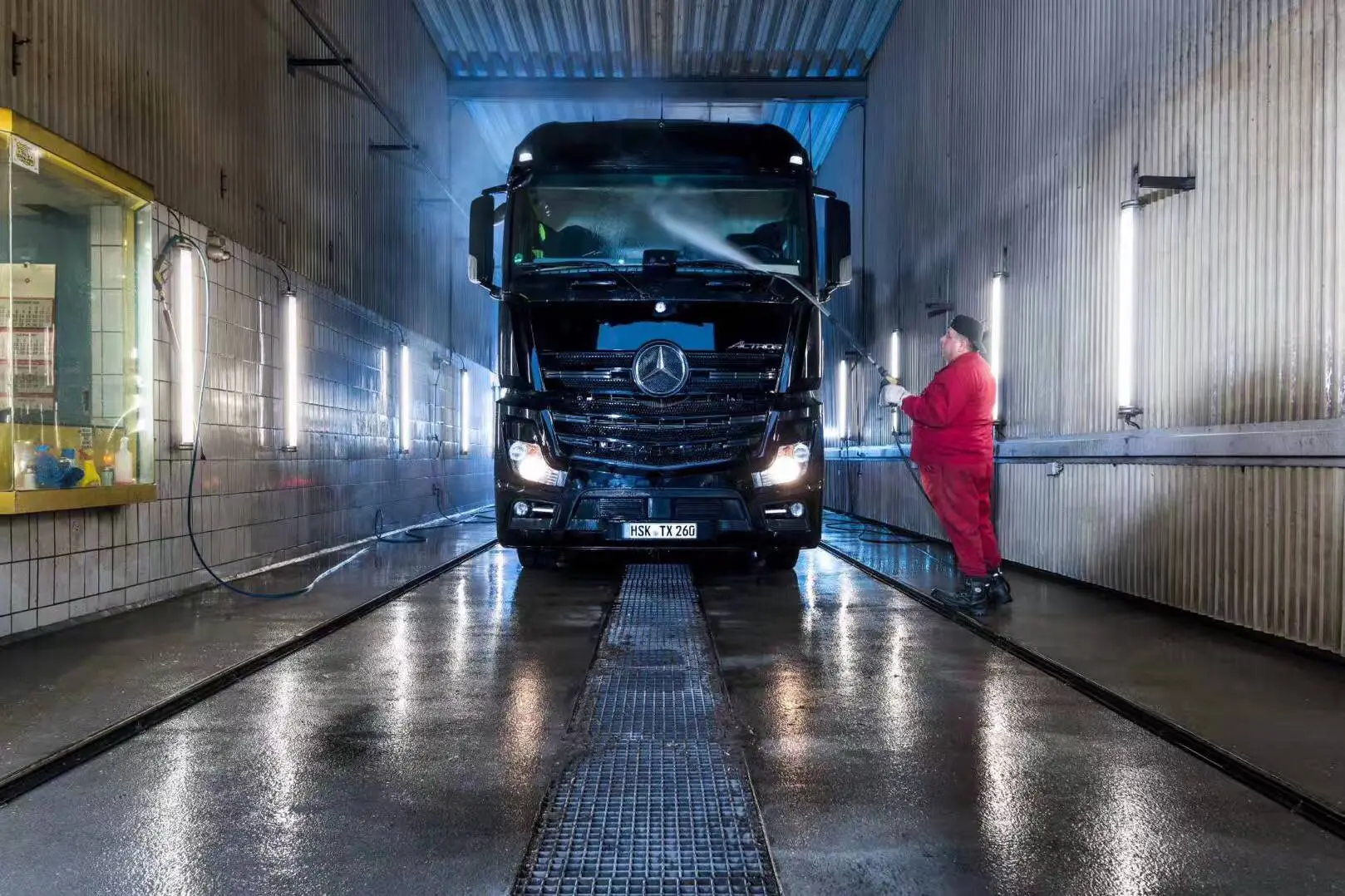
Sealed linear LED luminaire with splashing water in a wash bay

Under IEC 60529, the first digit in the IP code describes protection against access to hazardous parts and solid foreign objects. The second describes protection against water. IP65 and IP66 both denote dust-tight enclosures, with different water-jet tests. If a cleaning process uses close-range, hot, high-pressure jets, identify whether the project calls for IEC IP69 or ISO 20653 IP69K evidence. Request separate immersion evidence if the fixture may be submerged. See the IP69 and IP69K washdown comparison for report details.

Give the supplier the cleaning method, water temperature and pressure, spray distance, and the chemicals used. Review compatibility for the housing, lens, seals, and hardware, especially in coastal locations or chemical process areas. Where impact is likely, specify the required IEC 62262 IK rating separately. In areas with potentially combustible dust or vapours, have the responsible project specialist confirm the area classification and the corresponding luminaire approvals.

Match the ingress report to the proposed enclosure and cable entry, and review the installed connectors, plugs, and mounting instructions. A fixture can meet its lab test and still be compromised by an unsuitable field connection.

How Do You Verify Glare in a High Bay Layout?

Use the photometric file for the exact luminaire configuration and assess glare in the proposed geometry. A catalogue UGR value typically comes from reference conditions. Glare in use depends on the fixture’s light distribution and luminance, the space, and where people stand or look.
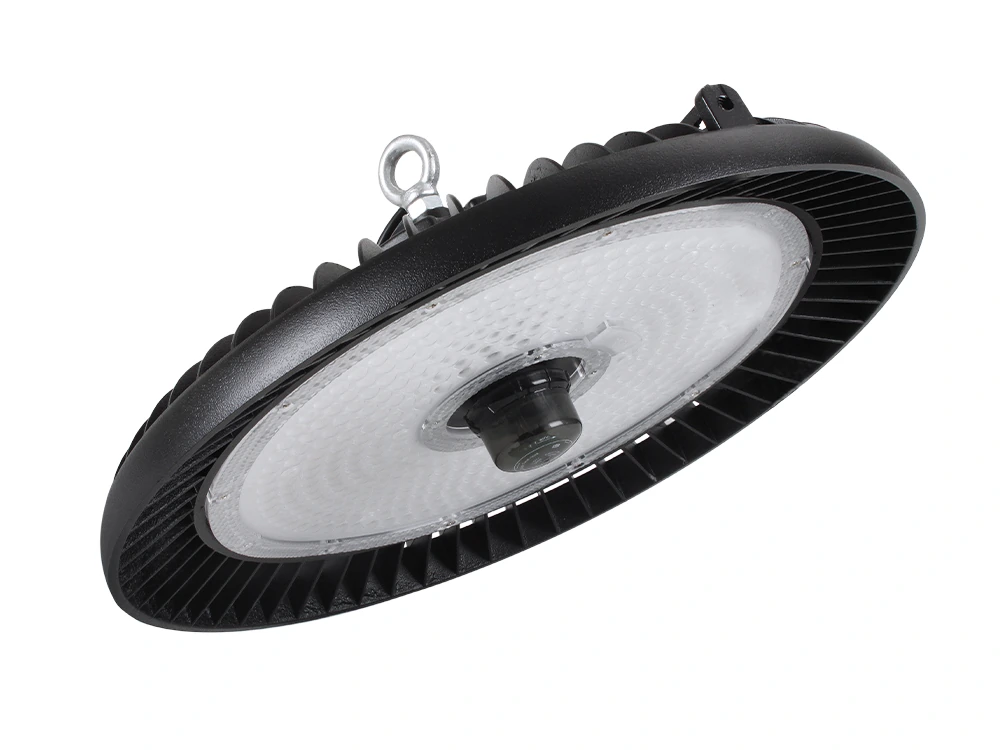
ShineLong ufo LED high-bay luminaire

Unified Glare Rating estimates discomfort glare for indoor lighting. In DIALux or equivalent lighting software, document the mounting height, row spacing, surface reflectances, and viewing directions. Check maintained illuminance and uniformity alongside the glare assessment. Use the method required by the project standard and confirm whether its tabular assumptions fit the space. DIALux UGR method guidance

If the result is borderline, compare a different optic, shielding, or fixture position and recalculate. In tall aisles, inspect the view of fixtures along forklift routes. At glossy inspection stations, evaluate reflections separately because UGR addresses discomfort from the lighting installation and can miss the reflected image that obscures a task. For help reading a datasheet claim, see ShineLong’s guide to verifying UGR claims.

Which Luminaire Specifications Affect Service Life?

Check the operating temperature at the fixture, the basis for the lumen-maintenance claim, and the availability of replacement components. Specify the driver and controls for the building’s electrical conditions and the planned operating schedule.

SpecificationWhat to ask the supplier
Luminaire efficacy Ask for delivered lumens and input watts for the quoted optic, output setting, and colour temperature. Compare luminaire lm/W, including driver losses, and then compare the total connected load for each compliant layout.
Ambient temperature and lumen maintenance Confirm the rated operating range and any derating at the fixture’s location. A claim of L80 at 50,000 hours describes a lumen-maintenance threshold of 80% of initial output at the stated time. Ask for the test and projection basis, plus separate evidence for driver life or warranty coverage.
Colour quality and flicker Specify colour temperature (CCT) and colour rendering (CRI or other required metrics) by task. For colour-sensitive inspection or camera use, validate a sample. For areas near moving machinery, discuss flicker and stroboscopic effects, including at dimmed settings.
Driver and electrical protection Confirm voltage, control compatibility, inrush current, power factor, and surge test conditions as required. Check the driver’s protection against the site electrical design.
Service and cleaning Ask which parts can be replaced on site, how the fixture is resealed, what spares are stocked, and whether servicing requires a lift or process shutdown. Verify warranty terms for the proposed operating and cleaning conditions.

An ANSI/IES LM-79 report documents initial optical and electrical measurements for the tested luminaire. LM-80 measurements and TM-21 projections address LED-source lumen maintenance. Ask how the supplier relates the source data to conditions inside the quoted luminaire and documents other possible failure modes. U.S. Department of Energy lighting metrics and test methods

How Do You Compare Energy Use and Total Cost?

Compare total installed load and lifecycle costs for layouts that satisfy the same lighting requirements. Choose an analysis period that reflects the owner’s plans for the building, and use the site’s operating hours and electricity tariff.

Annual lighting energy (kWh) = total input power (kW) × annual full-load-equivalent hours.

For illustration, suppose both layouts meet the same maintained illuminance, uniformity, and glare requirements. Layout A uses 60 fixtures at 150 W each, for 9.0 kW. Layout B uses 64 fixtures at 125 W each, for 8.0 kW. At 4,500 full-load hours and USD 0.12/kWh, Layout B uses 4,500 kWh less per year, a difference of USD 540 in annual energy cost. If Layout B costs USD 900 more to install, simple energy-only payback on that premium would be about 1.7 years. A shorter operating schedule or lower tariff would extend it.

For total cost of ownership (TCO), also compare installation, controls and commissioning, cleaning, spare parts, lift hire, labour, disruption, and end-of-life costs. Include applicable demand charges and use discounted cash flows if required by the buyer. When considering occupancy sensors or daylight dimming, model realistic activity and daylight by zone, include controls standby load where material, and verify savings after commissioning. U.S. Department of Energy commercial and industrial luminaire procurement guidance

What Should You Request Before Approving a Supplier?

Ask for a fixture schedule, a lighting calculation, and supporting reports tied to the exact models quoted. Agree on what the project team will verify at commissioning before placing the order.

  1. Project inputs. Provide a floor plan, mounting heights, racking or machine locations, site exposures, controls sequence, and task-level lighting targets.
  2. Proposed configuration. Request model codes, wattages, optics, mounting hardware, cable entries, drivers, and control options. Match each quoted variant to its datasheet and IES or LDT file.
  3. Evidence by zone. Request a calculation with the stated maintenance factor and results for relevant task planes. Ask for photometric, ingress, impact, or material compatibility evidence where the project requires it. Check that the report identifies the tested configuration.
  4. Installation and service. Obtain the wiring and mounting instructions, warranty terms, expected spare-parts availability, and procedures for servicing or resealing.
  5. Acceptance checks. Agree how the installer will confirm the fitted models, lighting levels at defined points and settings, and control behaviour. For a difficult aisle or inspection task, consider a trial installation before ordering the full quantity.

Frequently Asked Questions

Can I replace existing high bays one for one?

A one-for-one replacement can work if the existing mounting points and proposed optics meet the new project’s lighting targets. Verify the current racking or machine layout and model each task area before committing to the fixture count.

Is IP66 sufficient for industrial washdown?

IP66 may be sufficient where the expected water exposure is within the powerful water-jet test covered by the rating. For close-range, hot, high-pressure cleaning, specify the applicable washdown test separately and confirm material compatibility with the cleaning agents.

Does a UGR below 19 on a datasheet guarantee the same result on site?

A datasheet value below 19 applies to the stated reference conditions. Verify glare using the applicable method, the quoted fixture’s photometry, and the installation geometry and viewing conditions.

Does an L80 rating tell me when to replace the whole luminaire?

L80 describes lumen maintenance. Plan replacements using both the projected light output and other service factors, including driver reliability, cleaning, warranty scope, and spare-parts availability.

Get Lighting Design Support

Send ShineLong your floor plan, mounting heights, work zones, lighting targets, and environmental requirements. The team can help compare fixture configurations and identify the photometric files and technical documents needed for your evaluation.

Get Lighting Design Support

Latest Articles

Loading latest

Scroll to Top

Request Technical Support

Get professional advice on product selection, installation, and lighting requirements from our technical team.

Your information is secure and will never be shared with third parties.

Request Technical Documents

Get datasheets, certifications, test reports, and technical files directly from ShineLong.

Your information is secure and will never be shared with third parties.

Start Your Inquiry

Tell us what you need, and our team will reply within 24 hours.

Download Resources

We will send the resources to your mailbox once you have finished the email form. No Spam.

Start Your Project Solutions

Tell us about your project requirements, and our lighting engineers will prepare a suitable lighting solution within 24 hours.

Your information is secure and will never be shared with third parties.

Request a Quote

Get competitive pricing and professional support for your LED lighting requirements.

Your information is secure and will never be shared with third parties.

Get Full Product Catalog

Please enter your professional business email address to instantly unlock the catalog file download. No Spam.