COMMERCIAL LIGHTING GUIDE

How to Verify UGR<19 Lighting for Commercial Projects

Understand UGR, compare application needs, and review photometric evidence before selecting low-glare luminaires for people-focused indoor spaces.

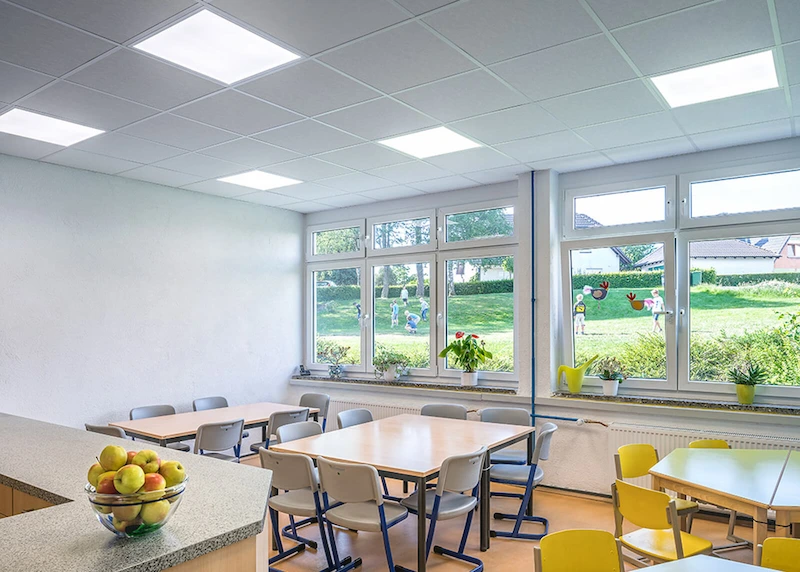
LED panel lights installed in an educational indoor environment
Uniform indoor lighting supports visually demanding learning and work areas.

Low glare is a project requirement, not just a fixture label

A space can meet its illuminance target and still feel uncomfortable when bright luminaires are visible from normal viewing positions. UGR, or Unified Glare Rating, helps designers assess discomfort glare in indoor lighting layouts.

For offices, classrooms, meeting rooms, and other screen- or task-focused spaces, UGR<19 is a common design target. It must be assessed in the actual room conditions, not inferred from fixture efficiency or diffuser appearance alone.

When the project also needs a panel-light format, explore ShineLong's commercial LED panel-light range and request the relevant photometric information for the planned layout.

Read the roomUGR changes with room dimensions, reflectance, observer position, and luminaire spacing.
Read the tableA UGR figure only has meaning when its calculation conditions and viewing directions are clear.
Read the applicationChoose the glare target around visual tasks, screen use, and the people occupying the space.

What does UGR measure in indoor commercial lighting?

UGR is an international discomfort-glare metric developed by the International Commission on Illumination (CIE). In practical terms, it estimates how uncomfortable a lighting installation may appear to an observer in a defined interior.

The lower the UGR value, the lower the predicted discomfort glare. It is not a stand-alone measure of brightness, colour quality, energy efficiency, or overall lighting quality.

UGR levelTypical visual impressionExample indoor use
UGR < 10Imperceptible glareLaboratories and inspection rooms
UGR < 16Very comfortableDrawing offices and technical work
UGR < 19ComfortableOffices, classrooms, and meeting rooms
UGR < 22AcceptableCorridors and industrial areas
UGR > 28Uncomfortable glarePoorly controlled lighting environments

Why does glare control matter in offices, schools, and healthcare spaces?

People in these environments often look between task surfaces, screens, signs, and other people for extended periods. Excessive glare can contribute to eye strain, headaches, visual fatigue, reduced concentration, and lower comfort even where the lighting level appears adequate.

  • Offices: screen work makes viewing angles and reflected brightness especially important.
  • Educational facilities: balanced lighting helps students focus on reading, writing, and display surfaces.
  • Healthcare settings: visual comfort supports patients and staff in spaces used throughout the day.
  • Retail and supermarkets: glare control can help maintain a more comfortable view of products and aisles.
  • Industrial and warehouse areas: glare should be considered alongside safety, visibility, mounting height, and task type.

How is a UGR result calculated for a real room?

A UGR calculation considers luminaire luminance, the observer's viewing angle, fixture position, room dimensions, surface reflectance, and background luminance. Lighting designers commonly use calculation software such as DIALux or Relux to model these relationships for the intended installation.

Important: A fixture cannot be meaningfully described as “UGR<19 for every project” without a stated calculation context. Ask for the room index, reflectance values, mounting arrangement, viewing direction, and the UGR table or simulation output.

Which optical choices can help manufacturers control glare?

Micro-prismatic diffusers

Optical diffuser structures can distribute light more evenly and help limit uncomfortable direct brightness.

Recessed light-source geometry

Setting the LED source deeper within the fixture can reduce direct exposure at common viewing angles.

Controlled reflectors

Reflector design directs light where it is useful and helps limit excessive luminance in sensitive angles.

Beam and material control

Beam distribution, lenses, and diffuser materials work together to balance visual comfort with useful output.

Is a lower UGR value always the best choice?

Not necessarily. A very low UGR target can affect optical design, efficiency, fixture cost, or the ability to deliver required illumination. The appropriate choice balances visual comfort, energy performance, brightness, installation cost, and the specific visual task.

For many commercial indoor projects, UGR<19 is a practical target for work and learning spaces. For applications with more demanding visual work, the design team may need a lower target and a more detailed calculation review.

What should buyers request before accepting a UGR<19 claim?

  • An official photometric report and its UGR table, with model number and tested configuration.
  • IES or LDT files for project-level calculation.
  • Optical details, including diffuser, reflector, lens, and recessed-source design where applicable.
  • The room assumptions behind any highlighted UGR result.
  • Project evidence or lighting calculations that match the intended installation conditions.

For a broader comparison of panel construction before this verification stage, see ShineLong's guide to selecting edge-lit and backlit LED panel lights.

How to read UGR data alongside photometric performance

The test-record examples below show why a UGR number should be read with its tested model, output, optical data, and room-condition table rather than used as an isolated marketing claim.

Tested configurationReported optical valueHighlighted UGR resultWhat the buyer should confirm
LED panel light, SL-P2240-W-18B, 40W, 4000K132.96 lm/W reported efficacy16.9–18.7 under the highlighted 8H table conditionsVerify the room dimensions, surface reflectance, viewing direction, and the exact optic used.
LED linear light, SL-B40X2-40-P, 40W, 5000K160.30lm/W reported efficacy9.8–13.1 under the highlighted 8H table conditionsCheck mounting height, luminaire spacing, light distribution, and whether the design assumptions match the project.

Values are presented from the supplied photometric report screenshots. They describe the recorded configurations and highlighted table conditions, not a universal UGR result for every installation.

Where should UGR<19 be evaluated most carefully?

Glare targets should reflect how people use the space. The same fixture may need different calculation checks when screen work, reading, clinical tasks, or product viewing changes.

LED panel lighting in a school setting
Educational areas benefit from balanced, task-friendly illumination.

Classrooms and training rooms

Review desk positions, whiteboards, viewing directions, and the visual demands of reading and screen-based learning.

LED panel lighting in a healthcare interior
Healthcare interiors require calm and dependable visual conditions.

Healthcare interiors

Consider the sightlines of patients, staff work areas, circulation zones, and the balance between comfort and required visibility.
LED panel lighting used in a retail environment
Retail lighting should support product visibility and customer comfort.

Retail and supermarket areas

Check shelf viewing angles, aisle geometry, reflected brightness, and the visual comfort of customers and employees.

Choose the fixture format after defining the glare target

The project brief should define the visual task and calculation conditions first. Then select a fixture family and request the model-specific UGR evidence needed for the final lighting layout.

Commercial LED Panel Lights

Suitable for ceiling-grid and indoor commercial projects where uniform general lighting and low-glare options are required.

Commercial office interior with ceiling-mounted panel lighting
Ceiling-mounted lighting in a commercial office environment.
Explore LED Panel Lights

Commercial LED Linear Lights

Suitable for continuous, suspended, recessed, or surface-mounted lighting layouts that need application-specific optical control.

Suspended LED linear lights in a meeting room
Suspended linear lighting in a meeting-room setting.
Explore LED Linear Lights

Frequently Asked Questions About UGR<19 Lighting

No. UGR<19 is meaningful only under the room, reflectance, mounting, observer, and viewing-direction conditions used in the calculation. Request the UGR table or a project-specific lighting simulation before confirming suitability.
Ask for the photometric report, model-specific UGR table, IES or LDT file, optical configuration, and lighting calculation that matches the planned room. These documents let the design team assess the claim in its intended context.
Offices commonly use UGR<19 as a practical target because occupants spend long periods reading, working at screens, and viewing colleagues or presentation surfaces. The final target should still follow the local project standard and task requirements.
Yes, but the balance depends on the optical design and application. Diffusers, reflectors, source recess, beam control, and the required illumination level should be assessed together rather than treating efficiency and glare as separate decisions.

Specify UGR with the room, not in isolation

ShineLong believes that low-glare selection starts with the visual task and ends with verifiable project data. Compare the luminaire's optical configuration, UGR table, and calculation conditions against the real room before approving a UGR<19 solution.

Need photometric files for a commercial lighting project?

Share your room dimensions, mounting plan, target illumination, and visual-task requirements. ShineLong can help you identify relevant technical documents and lighting options.

Request Technical Documents

Latest Articles

Loading latest articles...

Leave a Comment

Your email address will not be published. Required fields are marked *

This site uses Akismet to reduce spam. Learn how your comment data is processed.

Scroll to Top

Request Technical Support

Get professional advice on product selection, installation, and lighting requirements from our technical team.

Your information is secure and will never be shared with third parties.

Request Technical Documents

Get datasheets, certifications, test reports, and technical files directly from ShineLong.

Your information is secure and will never be shared with third parties.

Start Your Inquiry

Tell us what you need, and our team will reply within 24 hours.

Download Resources

We will send the resources to your mailbox once you have finished the email form. No Spam.

Start Your Project Solutions

Tell us about your project requirements, and our lighting engineers will prepare a suitable lighting solution within 24 hours.

Your information is secure and will never be shared with third parties.

Request a Quote

Get competitive pricing and professional support for your LED lighting requirements.

Your information is secure and will never be shared with third parties.

Get Full Product Catalog

Please enter your professional business email address to instantly unlock the catalog file download. No Spam.